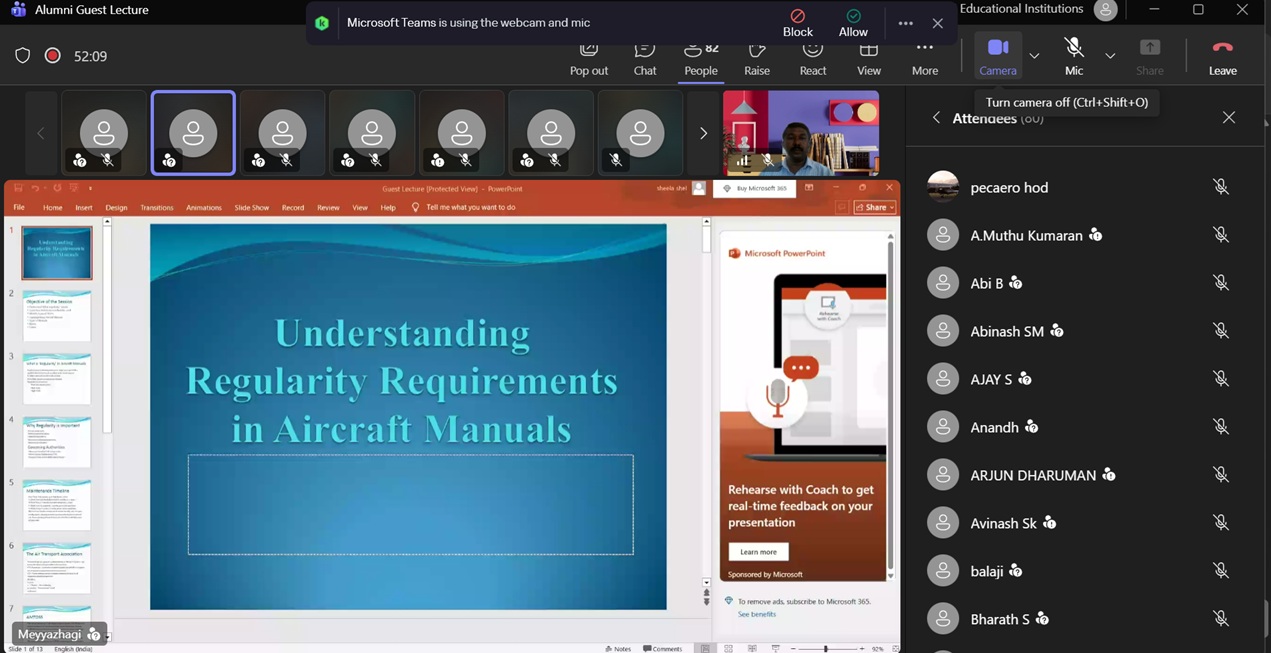
The Department of Aeronautical Engineering organized an Alumni Guest Lecture on 11.04.2026 through Online Mode (Microsoft Teams). The session was delivered by Ms.S.Meyyazhagi, Associate Engineer II at Capegemini Technology Services India Ltd, who belongs to the 2019-2023 Batch of the department.
The objective of the session is to provide students with a concise understanding of the importance of regulatory compliance in aviation documentation, familiarize them with various aircraft manuals and their structure, and expose them to real-world industry practices through alumni insights.
Ms.S.Meyyazhagi began the session by sharing her professional journey and highlighting the relevance of aircraft documentation in ensuring safety and compliance in the aviation industry. She explained the importance of regulatory requirements and provided an overview of various aircraft manuals such as AMM, IPC, and SRM, emphasizing their structure and practical usage in real-time maintenance and operations.
The lecture included practical insights into how these manuals are used in industry to maintain airworthiness, ensure standardized procedures, and support efficient decision-making. Students actively participated in the session by asking questions related to documentation practices, career opportunities, and industry expectations. The session concluded with an interactive discussion, encouraging students to strengthen their understanding of regulatory standards and develop the skills required to effectively interpret and apply aircraft manuals in professional environments.
A total of 95 participants attended the event, including 88 students and 7 faculty members.
By the end of this alumni guest lecture, students were able to understand the significance of regulatory requirements in aircraft manuals, identify different types of maintenance and operational documents, interpret basic procedures outlined in these manuals, and relate theoretical knowledge to practical industry applications.
POs and PEOs Coverage:
This session contributed to the attainment of the following:
Program Outcomes (POs):
- PO1 – Engineering Knowledge,
- PO2 – Problem Analysis,
- PO9 – Individual and Team Work
Program Educational Objectives (PEOs):
PEO1: Excel in professional career and higher education by acquiring knowledge in engineering principles through analytical, computational and experimental methods
SDG Alignment:
This event contributes to the Sustainable Development Goals (SDGs), particularly:
- SDG 9 – Industry, innovation and infrastructure
This is achieved by strengthening alumni engagement and enhancing students’ career readiness.